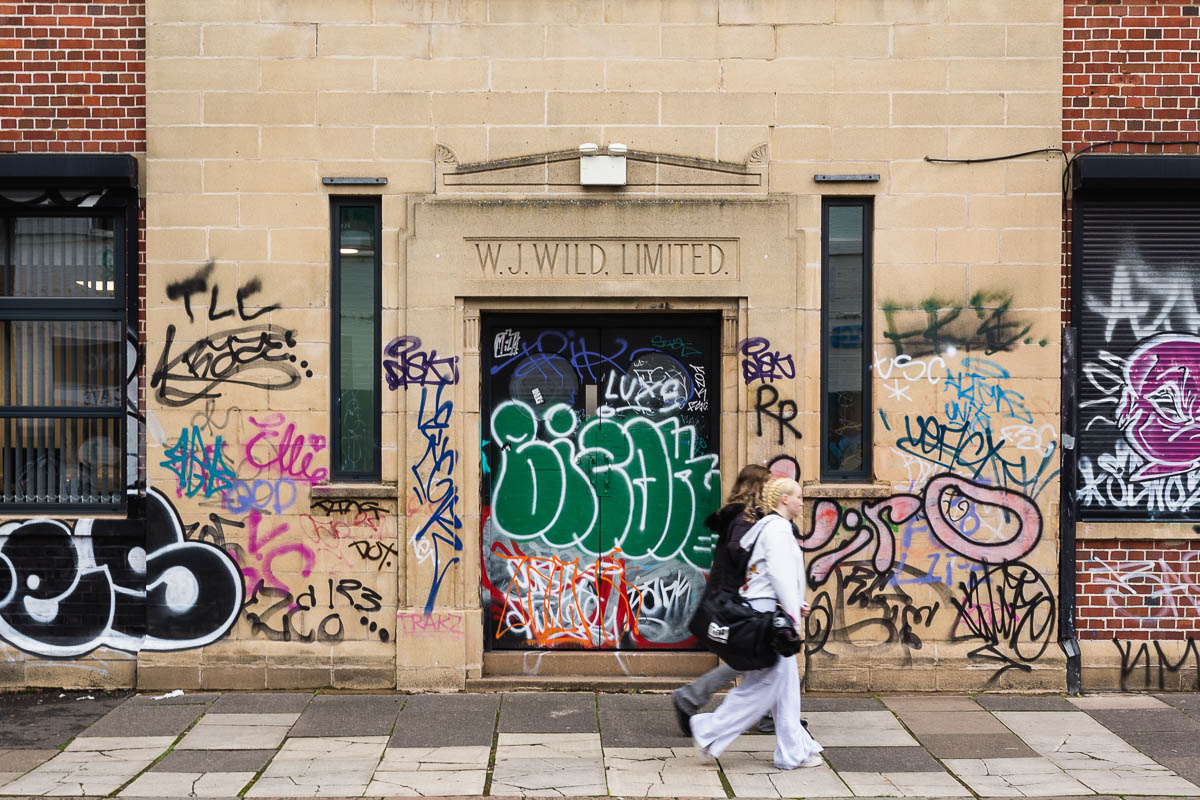
Cities are defined as much by their edges as by their landmarks. Urban Thresholds turns its attention to the overlooked margins of Birmingham: boarded-up doorways, service alleys, derelict workshops, and the backs of shops and factories. These are places most people pass without noticing, where entrances no longer open and the future often feels uncertain.
The photos explore doors, locks, shutters, and gateways as quiet traces of human presence. Layers of peeling paint, rust, graffiti, weathering, and improvised repair transform ordinary surfaces into records of occupation and change. Without depicting people directly, the work considers how these everyday thresholds bear witness to the lives, labour, and histories that have passed through them.
Working with expired colour film is integral to the project. Time has acted not only upon the buildings but also upon the photographic material itself. Colour shifts, grain, and imperfections echo the slow deterioration of the places they depict, moving the images away from straightforward documentation and towards memory. The medium becomes another surface shaped by time.
Doors and locks are practical objects, designed to secure property, define ownership, and separate public from private space. Yet many of the entrances in these photographs no longer fulfil their original purpose. Their locks remain in place, even when there seems to be little left to protect. Graffiti, stickers, and layers of paint interrupt these surfaces, creating a visual dialogue between authority and resistance, permanence and impermanence, order and improvisation. The threshold becomes a contested space where different histories and intentions accumulate.
Beyond their physical function, doors and locks also operate as psychological metaphors. They suggest the boundaries we create around ourselves, the parts of our lives we reveal or conceal, and the ways we negotiate vulnerability, belonging, and identity. Like the buildings they inhabit, these boundaries are rarely fixed. They are continually reinforced, altered, neglected, or opened.
Ultimately, Urban Thresholds is less concerned with architecture than with the idea of the threshold itself: the space between inside and outside, security and exposure, presence and absence, past and future. In Birmingham’s overlooked corners, these weathered entrances quietly remind us that every boundary tells a story—not only about what lies beyond it, but about what we choose to protect, preserve, and leave behind.